
Disclosure: As an Amazon Associate I earn from qualifying purchases. How this site works
DTG vs Screen Printing
Direct-to-garment printing works like an inkjet printer for fabric; screen printing pushes ink through stencils one colour at a time. Each wins in different situations.
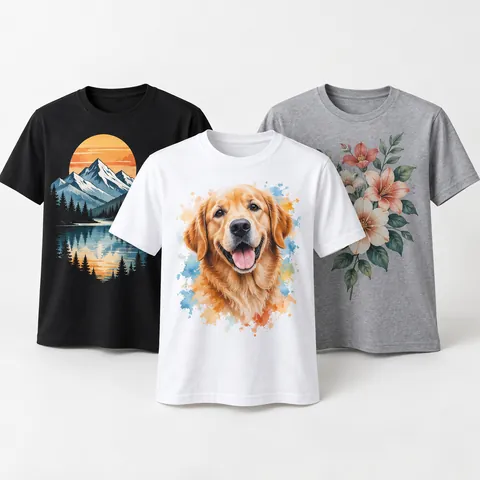 Custom t-shirt printing services (DTG/DTF)
 Bulk and screen-printed t-shirts
 Blank t-shirts for DIY printing
Side by side
| DTG | Screen printing | |
|---|---|---|
| Minimum order | One shirt | Often 12–24+ |
| Colours | Unlimited, photos and gradients | Each colour needs its own screen |
| Cost per shirt | Similar at any quantity | Falls sharply with quantity |
| Vividness on dark shirts | Good, can look softer | Excellent, bold |
| Durability | Good with proper care | Excellent |
| Feel | Soft, thin | Slightly thicker layer of ink |
Choose DTG when
- You need one or a few shirts.
- The design is a photo or has many colours or gradients.
- Each shirt is different (names, personal photos).
Choose screen printing when
- You need dozens or more of the same design.
- The design has a few solid colours.
- You want the most vivid, durable result for merchandise or uniforms.
Compare bulk screen-printed t-shirts and DTG printing services for current pricing.
How do I choose between DTG and screen printing for a real order?
Use the order details to narrow the choice before you ask for quotes. The fastest way is to write down the exact quantity, shirt color, number of design locations, and whether the artwork changes from shirt to shirt.
- Count every print location separately. A front-only shirt is simpler than a shirt with a front, back, and sleeve print.
- List how many shirt colors you want. The same art may need adjustment on white, black, and heather shirts.
- Decide whether the design is fixed or personalized. Names, numbers, photos, or different text on each shirt usually point toward DTG.
- Check the deadline. Screen printing may need more setup time, especially when screens must be made and approved.
- Ask for the total delivered cost, not just the print price. Setup fees, art cleanup, rush fees, shipping, and extra print locations can change the final comparison.
If the order is small and each shirt may be different, start with no-minimum custom t-shirt printing. If the order is a run of the same design for a team, staff, school, or event, compare bulk and screen-printed t-shirts before deciding.
What artwork is best for DTG vs screen printing?
Artwork quality affects the finished shirt as much as the printing method. A high-resolution file will not fix a weak concept, but a poor file can make a good design look blurry, jagged, or off-center.
| Artwork issue | Why it matters | What to do |
|---|---|---|
| Low-resolution image | Small web images can print soft or pixelated | Use the largest original file available; avoid screenshots |
| Tiny lettering | Small text can fill in, blur, or become hard to read | Increase the type size or simplify the design |
| Photos with shadows and gradients | These are difficult to separate into a few solid inks | Use DTG for the most direct reproduction |
| Flat logos with one to three colors | Simple shapes are efficient to separate and print | Use screen printing when the quantity justifies setup |
| Transparent backgrounds | A hidden white box can appear if the file is not prepared correctly | Send a PNG with transparency or a vector file when possible |
For screen printing, vector artwork is often preferred because edges stay sharp at any size. For DTG, a high-resolution raster file can work well, especially for photographs. Either way, ask for a digital proof that shows size, placement, garment color, and any design changes before production starts.
Does shirt fabric change the result?
Yes. The same print can look different on a smooth cotton tee than on a stretchy athletic shirt. Fabric texture, color, and fiber content all affect ink coverage, softness, and long-term wear.
- Smooth cotton is usually the easiest surface for both methods because it gives the ink an even base.
- Heavy texture, slub fabric, ribbed fabric, and seams can interrupt fine details.
- Polyester and performance blends may require special inks or processes, especially with screen printing.
- Very stretchy garments can stress the print when worn, so simple artwork and proper ink choice matter.
- Dark shirts usually need a white base layer under the colors, which can make the print feel slightly heavier than the same design on a light shirt.
If you plan to print at home or bring garments to a local shop, buy a few extras for misprints, sizing swaps, or test prints. For DIY projects, start with blank t-shirts for DIY printing that match the fiber and color recommended for your transfer or ink system.
What should I check before approving a custom t-shirt order?
Approval is the point where small mistakes become expensive. Take a few minutes to review the order like a printer would, not just like a shopper.
- Spelling, dates, names, phone numbers, and web addresses
- Print size in inches, not just a picture on a mockup
- Print placement, such as left chest, full front, back, or sleeve
- Shirt brand or fit type if that matters to your group
- Color names for both shirts and ink, since monitor colors are not reliable
- Whether youth, women’s, tall, or extended sizes need different print placement
- The return or remake policy for customer-approved art
If the order is important, ask whether a sample, pre-production proof, or photo of the first printed shirt is available. That may add time or cost, but it can prevent an entire run from being printed with the wrong placement or a hard-to-read color combination.
Frequently asked questions
Can you screen print a photo on a t-shirt?
Yes, but a photo usually has to be converted into halftones or separated into printable colors. That can work well in the right hands, but it is less direct than printing the photo with DTG. For a one-off photo shirt or a small batch, DTG is usually the simpler route.
Why does a DTG print sometimes show a faint square around the design?
That can come from pretreatment used to help ink bond to the fabric, especially on dark shirts. It often becomes less noticeable after washing, but the result depends on the garment, pretreatment, and curing. Ask the printer for care instructions before washing the shirt.
Can I mix shirt sizes and colors in the same order?
Sizes are usually easy to mix as long as the print size still works across the range. Mixing shirt colors can be more complicated because artwork may need different ink choices or a different underbase. Ask whether color changes add fees or require separate setups.
Will DTG or screen printing last longer?
A well-made screen print is often the safer choice when maximum durability is the priority. A properly printed and cured DTG shirt can still hold up well with normal care. Wash inside out, use mild detergent, avoid high heat when possible, and follow the printer’s instructions.
Can I bring my own shirts to a printer?
Some printers allow customer-supplied garments, and others do not. If they do, they may not guarantee results because they did not choose the fabric or control defects in the blanks. Always ask whether you need to provide extra shirts in case of setup errors or misprints.
Disclosure: As an Amazon Associate I earn from qualifying purchases. This site may earn a commission when you buy through its links, at no extra cost to you. Product details come from public manufacturer information; always check the merchant page for current specifications and prices. We have not hands-on tested the products described here.